My Friday began bright and early, well, early anyway. There wasn’t anything bright about the sky yet! But the moon was huge, like an illusion where it was touching the trees, bright and glow beautiful for sure.
I have a 7 AM MRI appointment about 35–40 minutes from home, so I gave myself plenty of time. At 6:15 AM, while driving through Lake Mary, my front wheels had just reached a standard railroad crossing when the red lights started flashing and the train warning sounded.
Let me tell you ….that scared the daylights out of me, and daylight hadn’t even arrived yet!
If I wasn’t fully awake before that moment, I certainly was afterward. My heart got a little exercise I had absolutely no intention of putting on today’s schedule.
Everything looks different in the dark, especially when you’re driving through an unfamiliar area. Once I arrived safely at my appointment, I took a moment to pray.
“Thank You, Lord, for getting me here safely.”
and can you please do something about the little insects called no-see-ums it seems to like to fly in the dark and attack me on the way to the car no matter where I am located lol a.k.a. biting midges Florida….
Then I really thought about what I was thankful for: those flashing red lights, that startling warning, and the safety systems doing exactly what they were meant to do. They certainly got my attention. I wasn’t trying to cross on a red flashing light, but it’s like when somebody is playing a game show and you suddenly win in the lights go off and on exciting exhilarating and scary all at the same time..
Sometimes gratitude comes easily. Other times, it arrives at 6:15 in the morning with flashing lights and a very loud announcement!
This morning reminded me how much I have to thank God for, even before the sun comes up. A safe arrival. Another day. A moment to catch my breath and recognize His goodness in the middle of an ordinary and briefly startling, Friday morning.
So today, I’m choosing gratitude. I’m thankful I made it safely across, thankful for the people who help keep our roads and crossings safe, and thankful that God welcomes a prayer whether it’s beautifully worded or simply, “Oh, Lord, thank You!”
And yes, I’m also very thankful it’s Friday.
May your day hold more peace than surprises, may your weekend be beautiful, and may you find a reason to thank God somewhere along the way.
A Survivor’s Story of Faith, Domestic Violence, and Finding the Courage to Leave
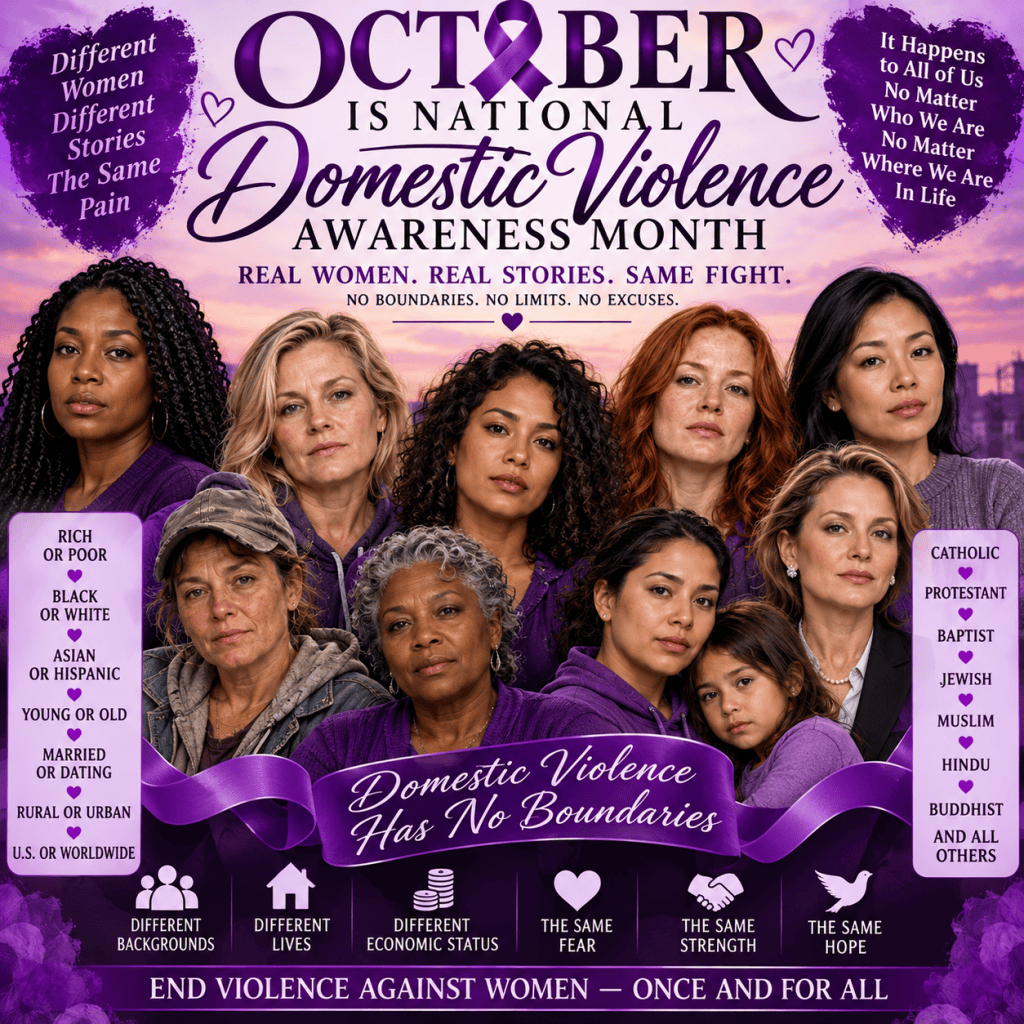
October Is National Domestic Violence Awareness Month
October is National Domestic Violence Awareness Month, and this is a subject that will forever be close to my heart.
Why? Because I am a survivor.
I was a battered wife in my first marriage. I know what it feels like to live in fear, to walk on eggshells, to wonder what kind of mood your husband will be in when he walks through the door. I know what it feels like to pray for the abuse to stop, to hope that this time he really means it when he says he’s sorry, and to believe that somehow tomorrow might be different.
And I know what it feels like to finally find the courage, faith, and opportunity to get out.
This is why I will never stop speaking up for women who are living through domestic violence.
Because somewhere today, a woman is smiling at work, laughing with her coworkers, taking care of her children, and pretending everything is fine.
But underneath her clothes, she may be covered in bruises. She probably is dreading her workday being over because she knows he she will have to go back to the abuse verbally physically sexually financially mentally.
And nobody knows what she lives with.
Stop Asking Women Why They Stay. Start Asking Men Why They Abuse.
One thing that absolutely breaks my heart and makes me angry is hearing people ask a battered woman:
“Why don’t you just leave?”
“Why do you stay with him?”
“Why do you put up with it?”
Let me ask you something.
Why aren’t we asking the abuser why he hits her?
Why does he slap her?
Why does he punch her?
Why does he call her worthless, stupid, ugly, fat, too skinny, or tell her that nobody else would ever want her?
Why does he feel entitled to control her every move?
Why does he think that being her husband or boyfriend gives him the right to terrorize her?
Why is it that she goes and gets a restraining order gets it enforced the police arrest him and the courts let them free all within a day. Only making him more pissed off to come and get her again..
Why is it that she has to be the one to keep moving from city to city town to town when she does attempt to leave and yet he finds her and stocks her threatens to come and steal his children or kill her in front of her children and this is allowed, but God forbid a person goes to jail for beating up a total stranger or kicking a dog not that I’m saying that any of those are right, but what makes domestic violence less of a crime than any other form of assault?
Why are we so quick to question the woman who is suffering instead of holding the man who is hurting her accountable?
I am tired of watching society put the responsibility on the victim.
Unless you have lived in an abusive relationship, you cannot fully understand what it is like.
Sometimes a woman cannot simply pack a suitcase and walk out the door.
Maybe she has children.
Maybe she has no money because her husband controls every penny.
Maybe she has no car, no family nearby, or nowhere safe to go.
Maybe he has threatened to kill her if she leaves.
Maybe he has threatened to take her children away.
Maybe she is being tracked through her phone, an AirTag hidden in her car, or some other device.
Maybe she is so emotionally beaten down that she no longer believes she can survive without him.
And maybe, just maybe, she is quietly making a plan to save her own life.
She may be saving money a few dollars at a time.
She may be gathering important documents.
She may be waiting for a safe opportunity to leave.
She may be trying to figure out how to protect her children.
So please, before you judge a woman for staying, remember that you have no idea what she may be going through behind closed doors.
No woman wants to be beaten. No woman wants to be humiliated. No woman wants to live in fear.
And no woman deserves it.
Domestic Violence Does Not Discriminate — It Has No Boundaries
There is something else I want people to understand about domestic violence.
Abuse does not care about your race, your religion, your bank account, your education, your social standing, or who your husband is.
You can be a preacher’s wife.
You can be a police officer’s wife.
You can be a firefighter’s wife.
You can be a doctor’s wife.
You can be a lawyer’s wife, a politician’s wife, a businessman’s wife, or the wife of a man everybody in town thinks is wonderful.
And you can still be getting beaten behind closed doors.
You can live in a million-dollar mansion or a one-bedroom apartment.
You can drive a Mercedes or take the bus.
You can wear designer clothes or shop at a thrift store.
Domestic violence does not discriminate between the rich and the poor.
You can be Black, white, Asian, Hispanic, Native American, or any other race or ethnicity. And as I like to say, you could practically be a Martian. Abuse does not care!
You can be Catholic, Protestant, Baptist, Jewish, Muslim, Hindu, or belong to any other faith.
You can attend church every Sunday, sit in the front pew, sing in the choir, teach Sunday school, or be married to the very man standing behind the pulpit preaching about God’s love.
And still go home to a man who terrorizes you.
Let that sink in.
A man’s profession, position in the community, religious title, or reputation does not automatically make him a good husband.
Some abusive men are respected members of their communities. They may be charming, generous, successful, and admired by everyone around them.
But the woman living inside their home may know an entirely different man.
That is one reason women are sometimes afraid to speak up.
Who is going to believe the preacher’s wife when she says her husband beats her?
Who is going to believe the police officer’s wife when her husband is respected by the very people she might need to call for help?
Who is going to believe the doctor’s wife when everyone assumes she has a perfect life because she lives in a beautiful home and has financial security?
People look at these women and think, “What could she possibly have to complain about?”
You have no idea.
Money does not stop a fist.
A beautiful home does not guarantee a peaceful home.
A wedding ring does not guarantee love.
And sitting in church on Sunday does not excuse what a man does to his wife on Monday.
Domestic violence happens in cities, small towns, rural communities, and countries all around the world.
It happens to educated women and women who never finished school.
It happens to young women, middle-aged women, and elderly women.
It happens to women who work outside the home and women who stay home raising their children.
There is no economic standard, no racial boundary, no religious exemption, and no profession that makes a family immune to domestic violence.
And I want to make something else perfectly clear.
Just because a woman has money does not mean she has freedom.
Her husband may control every bank account, every credit card, and every dollar she spends.
Just because a woman is married to a powerful or respected man does not mean she has someone she can safely turn to.
Sometimes the very position her husband holds makes her even more afraid to tell the truth.
So please stop assuming you know what abuse looks like.
It does not have one face.
It does not have one skin color.
It does not belong to one religion or one income bracket.
And it certainly does not happen only to women who are poor or uneducated.
Domestic violence can happen to any woman, anywhere in the world.
As a Christian, I believe we are called to protect those who are suffering, not protect an abuser’s reputation because of his title, profession, or standing in the community.
Proverbs 31:8-9 tells us:
“Open thy mouth for the dumb in the cause of all such as are appointed to destruction. Open thy mouth, judge righteously, and plead the cause of the poor and needy.” (KJV)
We need to speak up for women who are afraid to speak for themselves.
We need to believe survivors.
We need to hold abusers accountable, regardless of who they are or what they do for a living.
And we need to stop pretending domestic violence is somebody else’s problem.
Because domestic violence has no boundaries, and neither should our compassion, our advocacy, or our determination to end violence against women once and for all.
God Never Commanded a Woman to Be a Punching Bag
This is where my Christian faith becomes such an important part of my story.
During my first marriage, I prayed constantly.
I prayed that my husband would stop hitting me.
I prayed that he would change.
I prayed that God would somehow fix our marriage.
I went to church looking for answers, looking for hope, and looking for someone to tell me what I was supposed to do.
And do you know what some churches told me?
“You need to stay with your husband.”
They emphasized marriage, commitment, and staying together.
But what about my life?
What about my safety?
What about my daughter?
What about the fact that I was being physically and emotionally destroyed?
I carried those words with me, believing that perhaps being a good Christian wife meant enduring the abuse.
Until one day, I finally found a church that told me something I desperately needed to hear.
“God never said you needed to be beaten. It is time for you to make a plan to get out.”
Those words helped change my life.
Because God did not create women to be punching bags.
He did not create marriage so that one person could dominate, humiliate, threaten, or terrorize another.
The Bible tells us in Ephesians 5:25:
“Husbands, love your wives, even as Christ also loved the church, and gave himself for it.” (KJV)
Love your wives.
Not beat your wives.
Not threaten your wives.
Not control your wives.
Not destroy your wives emotionally until they feel worthless.
And Colossians 3:19 tells us:
“Husbands, love your wives, and be not bitter against them.” (KJV)
There is nothing Christlike about a man who uses his fists, his words, his money, or his power to terrorize the woman he claims to love.
Abuse is not love. Control is not protection. Fear is not respect. And submission does not mean accepting violence.
A marriage covenant is not a license to abuse.
And I believe with all my heart that God does not expect a woman to sacrifice her life to prove she is a faithful Christian wife.
There Were Days I Prayed for Death
This is not easy for me to share, but I believe that telling the truth may help another woman.
There were days during my first marriage when the beatings became so unbearable that I prayed for death.
I wanted the pain to stop.
I wanted the fear to stop.
I wanted the nightmare to end.
But then I would think about my daughter.
And sometimes, in my desperation, I prayed that he would die instead of me.
Not because I wanted to be a hateful person, but because I was terrified of leaving my daughter behind with a man who used violence whenever he didn’t get his way.
I was a mother trying to survive.
I was a woman living in fear.
And I was desperate for a way out.
Looking back today, I thank God that I escaped when I did.
Because I truly believe that if I had stayed in that marriage, I would not be alive today.
That is how serious domestic violence can become.
This is not just about a bad argument.
This is not just about a husband having a temper.
This is not just about a couple going through a difficult season.
Domestic violence can be a matter of life and death.
The Cycle of Abuse: Why Women Keep Hoping He Will Change
People who have never experienced domestic violence often do not understand the cycle that keeps so many women trapped.
In many abusive relationships, there is a repeating pattern.
First comes the tension.
You can feel something building. Maybe he is getting angry more often. Maybe he is criticizing everything you do. You start watching every word you say, trying not to upset him.
You walk on eggshells.
Then comes the abuse.
It might be screaming, name-calling, threats, shoving, slapping, punching, or something even worse.
Then comes the apology, sometimes called the honeymoon phase.
He cries.
He says he’s sorry.
He promises it will never happen again.
He tells you how much he loves you.
Maybe he buys flowers or gifts.
Maybe he promises to go to church, get counseling, or become a better man.
And because you love him, and because you desperately want your family to stay together, you believe him.
Then comes the calm.
For a while, things seem normal.
You begin to relax.
You think perhaps your prayers have finally been answered.
Until the tension starts building again.
And the cycle repeats.
Not every abusive relationship follows this exact pattern. Some abusers never apologize, and some use control and intimidation without physical violence.
But I know firsthand how powerful the hope of change can be.
Sometimes the abuse begins with something a woman tries to convince herself is minor.
A cruel comment.
A controlling demand.
A shove.
A slap.
But let me tell you something from experience.
The first slap is already abuse. You do not have to wait for a worse beating to take it seriously.
Abuse can escalate, and the danger can become greater over time.
An apology means very little when the same behavior continues.
Real change requires accountability, sustained effort, and an end to abusive behavior. Promises alone are not enough.
Please do not gamble your life on the hope that someday he might become the man he keeps promising to be.
Parents, We Must Teach Our Daughters AND Our Sons
Moms and dads, I want to speak directly to you.
Please teach your daughters how to recognize the warning signs of an abusive relationship.
Teach them that jealousy is not proof of love.
Teach them that a boyfriend demanding to know where they are every minute of the day is not necessarily being protective.
Teach them that someone checking their phone, tracking their location, isolating them from friends, or telling them what they can wear is displaying controlling behavior.
Teach them that a man who constantly insults them, embarrasses them, or makes them feel small is not treating them with love.
Teach them that they never have to earn respect by tolerating mistreatment.
But parents, we cannot stop with our daughters.
We must teach our sons not to become abusers.
Teach your sons that women are not property.
Teach them that being a man does not mean being in control of another human being.
Teach them that anger does not give them permission to hurt someone.
Teach them to respect boundaries.
Teach them to treat their girlfriends with dignity, kindness, and respect long before they ever become husbands.
Teach them that marriage is a partnership, not a dictatorship.
Genesis 1:27 reminds us that both male and female were created in the image of God.
That means a woman’s dignity and worth are not less than a man’s.
A godly man does not need to intimidate a woman to feel powerful.
A godly man understands that love and respect go hand in hand.
And our children need to see that example in the home.
You Never Know What the Woman Sitting Next to You Is Going Through
I want you to think about the women you encounter every day.
The woman sitting beside you at church.
The cashier at the grocery store.
Your coworker.
Your neighbor.
The mother standing beside you at your child’s school.
She may be laughing.
She may be beautifully dressed.
She may seem like she has everything together.
But you do not know what happened in her home the night before.
You do not know whether she has bruised ribs.
You do not know whether her back is covered in black-and-blue marks.
You do not know whether she cried herself to sleep.
Abusers often hurt women in places where the bruises can be hidden.
And sometimes they do not care who sees the injuries.
A woman may be punched in the mouth, slapped across the face, or publicly humiliated.
Then she may be expected to get up the next morning and pretend everything is normal.
So instead of judging her, be her friend.
Listen to her.
Believe her.
Do not shame her.
Do not tell her she is stupid for staying.
Do not pressure her to leave before she has a way to do so safely.
Ask how you can help.
Sometimes having one person who believes you can make all the difference in the world.
Galatians 6:2 says:
“Bear ye one another’s burdens, and so fulfil the law of Christ.” (KJV)
That is what Christians should be doing.
Not judging.
Not blaming.
Not looking the other way.
But helping carry the burdens of people who are suffering.
Churches Need to Be Safe Places for Abused Women
I want to say something to pastors, church leaders, and fellow Christians.
Please be careful what you tell a woman who comes to you and says her husband is abusing her.
Do not simply tell her to pray harder.
Do not automatically tell her to be more submissive.
Do not make her feel that protecting herself and her children means she is disappointing God.
Prayer is powerful. I believe that with all my heart.
But a woman can pray while also making a plan to get somewhere safe.
Faith and action can go together.
Proverbs 22:3 tells us:
“A prudent man foreseeth the evil, and hideth himself: but the simple pass on, and are punished.” (KJV)
Recognizing danger and taking steps toward safety is not a failure of faith.
Churches should be places where abused women can find compassion, practical help, and protection.
I am grateful that I eventually found a church that recognized the seriousness of what I was experiencing.
A church that did not tell me to keep enduring the beatings.
A church that helped me understand that I needed to make a plan to leave.
Those words gave me hope when I desperately needed it.
God Showed Me That Good Men Still Exist
My story did not end with my first marriage.
And for that, I am incredibly grateful.
After escaping that abusive relationship, I eventually dated a man who treated me with kindness and respect.
Our relationship did not last, but I will always appreciate what that experience showed me.
There were good men in the world.
Men who could disagree without becoming violent.
Men who could treat a woman with respect.
Men who did not need to control or intimidate someone to feel secure.
And then, later in life, I met my second husband.
What an amazing blessing he has been.
I am so grateful that God put him in my path.
He has shown me what it means to be loved and respected in a marriage.
What it means to feel safe.
What it means to have a husband who treats you as a partner rather than someone he needs to control.
I share this because I want women to know that abuse does not have to define the rest of their lives.
There can be peace after fear.
There can be joy after pain.
There can be healing after trauma.
And whether or not another relationship is ever part of your future, you deserve a life where you are safe, respected, and free from abuse.
Domestic Violence Awareness Should Not End on October 31
October is Domestic Violence Awareness Month, but domestic violence does not take a break during the other eleven months of the year.
Please remember the women and children living in shelters.
Remember the women who escaped with nothing but the clothes on their backs.
Remember the mothers who are trying to rebuild their lives while protecting their children.
If you can, donate to a local domestic violence shelter in your county.
Give money.
Give clothing or household necessities that the shelter has requested.
Give your time.
Ask what they need most.
And please remember these shelters throughout the entire year, not just during the holidays.
Holidays, major celebrations, and sporting events can be especially stressful or dangerous in some abusive homes. What should be a joyful occasion may become another time of fear for a woman living with violence.
Whether it is Christmas, New Year’s, summer holidays, or Super Bowl Sunday, remember that not every family is celebrating behind closed doors.
Some are simply trying to survive.
To the Woman Who Is Being Abused Right Now
If you are reading this and you are living with an abusive husband or boyfriend, I want to speak directly to you.
You are not worthless.
You are not ugly.
You are not stupid.
You are not unlovable.
You are not the terrible things he has called you.
You are a woman created in the image of God.
You have value.
You have dignity.
And you deserve to live without fear.
Please understand that you cannot love someone enough to make him stop abusing you.
You cannot be quiet enough, pretty enough, thin enough, obedient enough, or perfect enough to prevent another person’s decision to use violence.
His abuse is his responsibility.
Not yours.
And if you are not able to leave today, that does not make you weak.
I understand.
I have been there.
Sometimes you need time.
Sometimes you need money.
Sometimes you need help.
Sometimes you need a carefully thought-out safety plan.
Please reach out to a trusted person or a domestic violence advocate who can help you make that plan safely. Leaving can be a particularly dangerous time, especially when an abuser has threatened violence or is monitoring your movements.
If your phone or car is being tracked, seek advice about communicating safely before making changes that might alert him.
Do not announce your plans to an abusive partner if doing so could put you in danger.
You do not need to have everything figured out before asking for help.
And please remember that you do not have to wait until he hurts you again to deserve safety.
My Final Message: Please Stop Judging and Start Helping
I have lived through the terror of domestic violence.
I have prayed through beatings.
I have feared for my life.
I have worried about what would happen to my daughter.
I have listened to people tell me to stay.
And I have experienced the freedom of finally getting out.
That is why I will never stop advocating for battered women.
That is why I will never be silent when someone blames a woman for staying with an abusive man.
And that is why I want every woman reading this to understand one simple truth.
God never wanted you to be beaten.
He never commanded a husband to terrorize his wife.
He never said that marriage required a woman to endure violence.
And He never said that being a good Christian meant allowing someone to destroy you.
Psalm 34:18 says:
“The LORD is nigh unto them that are of a broken heart; and saveth such as be of a contrite spirit.” (KJV)
To the woman who is suffering, I pray you find safety, support, and the opportunity to begin a new chapter.
To the woman who has escaped, I pray you continue to heal.
To the woman who is quietly planning her way out, I pray that trustworthy people and safe resources come alongside you.
And to everyone else, I ask you to stop saying, “Why doesn’t she just leave?”
Instead, ask:
“Why is he abusing her, and what can I do to help her be safe?”
Because the next woman you judge may be fighting for her life.
And the kindness you show her today may help her find a way to survive tomorrow.
I know.
Because I was once that woman.
And by the grace of God, I am still here to tell my story.
If You or Someone You Love Needs Help
In the United States, contact the National Domestic Violence Hotline:
Trained advocates can help with safety planning, finding local resources, and exploring options. If your internet or phone use is being monitored, try to contact them from a safer device.
If you are in immediate danger, call 911 when it is safe to do so.
Domestic violence is never the victim’s fault. You deserve safety. You deserve respect. And you deserve to live.
October is National Domestic Violence Awareness Month. Please share this message. You never know whose life it might touch.
Here is a link to all domestic violence shelters within the United States
One of the most beautiful things about being a grandparent is watching our grandchildren grow into the adults God created them to be.
But if we’re truthful, it can also tug at our hearts in ways we didn’t expect.
It seems like yesterday they were little.
Little hands reaching for ours. Little voices calling our names. They had time to sit with us, ride in the car with us, spend the night, tell us their stories, and simply be near us.
Back then, they needed us in so many little ways.
And then we blink.
The child becomes a teenager, the teenager becomes a young adult, and before we know it, we’re watching them graduate, begin careers, fall in love, build homes, travel, marry, and create lives of their own.
And we couldn’t be prouder.
There is something incredibly special about looking at a successful, capable adult and remembering the little child they used to be.
What a privilege to have had a front-row seat to their becoming.
Yet somewhere in all that pride is another feeling grandparents don’t always talk about.
As their lives become fuller, we sometimes quietly wonder:
Will they still have time for us?
Not because we want to hold them back.
Quite the opposite.
We prayed for them to grow up.
We prayed for them to become independent.
We prayed that doors would open, that they would find meaningful work, good people, love, purpose, and happiness.
We wanted them to have full lives.
And then God answers those prayers—and suddenly their lives really are full.
Careers become demanding. Relationships become important. Friends, responsibilities, travel, homes and eventually families of their own fill their calendars.
They don’t need Grandma and Grandpa the way they once did.
And that’s where a grandparent’s heart has to learn a new kind of love.
We have to let the relationship grow up too.
We don’t want our grandchildren spending time with us because they feel guilty or obligated.
We want them to call because they want to hear our voices.
We want them to visit because our home still feels like home to them.
We want them to sit at our table because they enjoy being there.
We want to hear about their careers, their dreams, their accomplishments, their disappointments, their funny stories and even the ordinary details of their lives.
And perhaps most of all, we want them to know that even though they don’t need us like they did when they were little, there will always be a place in our hearts and our lives where they belong.
So we learn not to hold too tightly.
We try not to make them feel guilty when they’re busy.
We don’t measure their love by the number of phone calls or visits.
We remind ourselves that their independence isn’t rejection.
It’s what growing up looks like.
And instead of trying to remain at the center of their lives, we become a steady place on the side of the road.
A place where they are always welcome.
A voice that encourages rather than controls.
An ear that listens without immediately correcting.
A heart that celebrates their victories without taking credit for them.
A home where they can walk through the door at 8 or 28 or 48 and know one thing hasn’t changed:
They are deeply loved here.
There may be times when we don’t agree with every decision they make. They may see the world differently than we do. Their generation isn’t ours, and their journey with God belongs to them.
We can share wisdom when it’s welcomed, but we also have to respect the adults they’ve become.
Sometimes the most loving thing a grandparent can say is:
“I trust you. I’m proud of you. I’m here if you need me.”
And then we pray.
Oh, how grandparents pray.
We prayed for them when they were little, and perhaps we pray even more now that they’re grown.
We pray over their careers and relationships.
We pray for their health and safety.
We pray that God gives them wisdom.
We pray that they will know Him and walk closely with Him.
We pray over decisions they may never even tell us they’re making.
And yes, sometimes we pray a little prayer for ourselves too:
“Lord, as their world gets bigger, please let there always be a little room in it for us.”
Not because we want them to stay children.
We don’t.
We want them to fly.
We just hope that every once in a while, they’ll fly home.
Proverbs 17:6 says:
“Children’s children are a crown to the aged.”
What a crown they are.
What a blessing to have known them as babies, watched them become children, cheered them through the growing years, and now have the privilege of knowing them as adults.
The relationship changes.
It has to.
But different doesn’t have to mean distant.
In fact, there is something beautiful waiting on the other side of childhood—a relationship where we aren’t simply Grandma and Grandpa taking care of a little one anymore.
We become friends.
We laugh together.
We share stories.
We learn from them, too.
We watch with pride as they make their own way in this world.
And every now and then, we catch a familiar expression or hear a certain laugh, and for just a second we see that little child again.
Our hearts remember.
They may outgrow our laps.They may outgrow needing our help.They may build lives that are wonderfully full and busy.
But they will never outgrow our love.
So we loosen our grip, keep our door open, and place them in God’s hands.
And when they call just to talk, walk through the door unexpectedly, ask what we’re doing this weekend, or sit down beside us like they did all those years ago…
we treasure it.
Because one of life’s greatest blessings isn’t simply watching our grandchildren grow up.
It’s discovering that after they grow up, they still choose to come back and spend a little time with us.
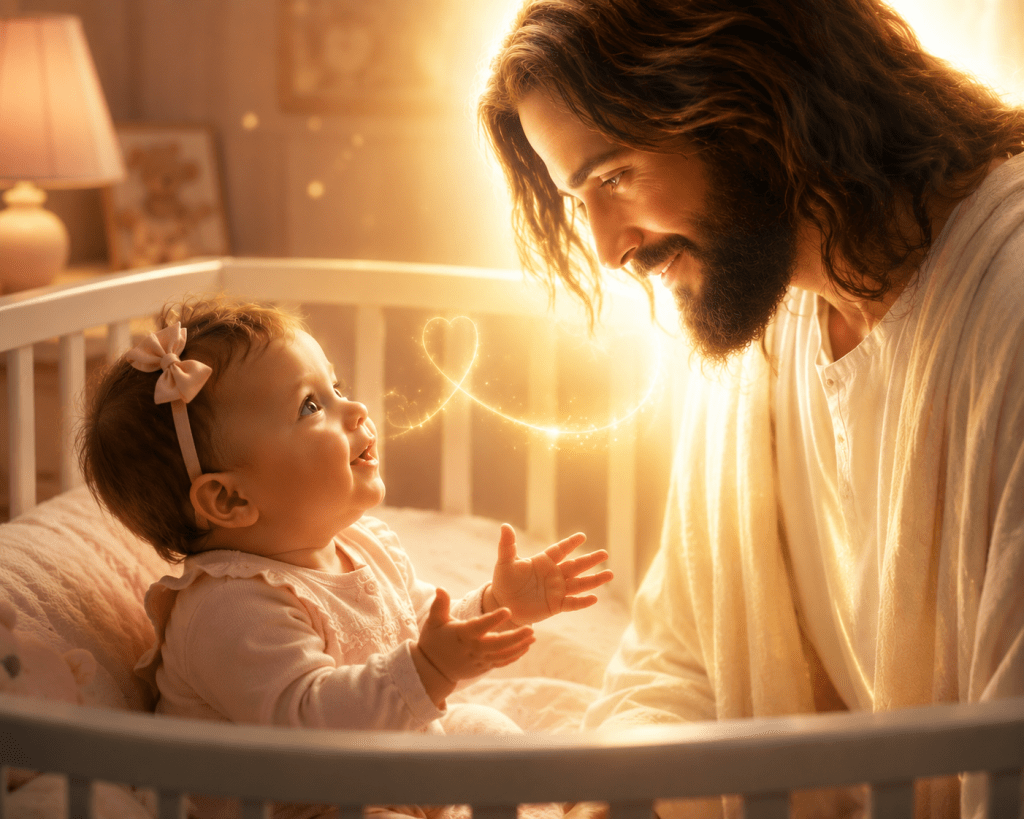
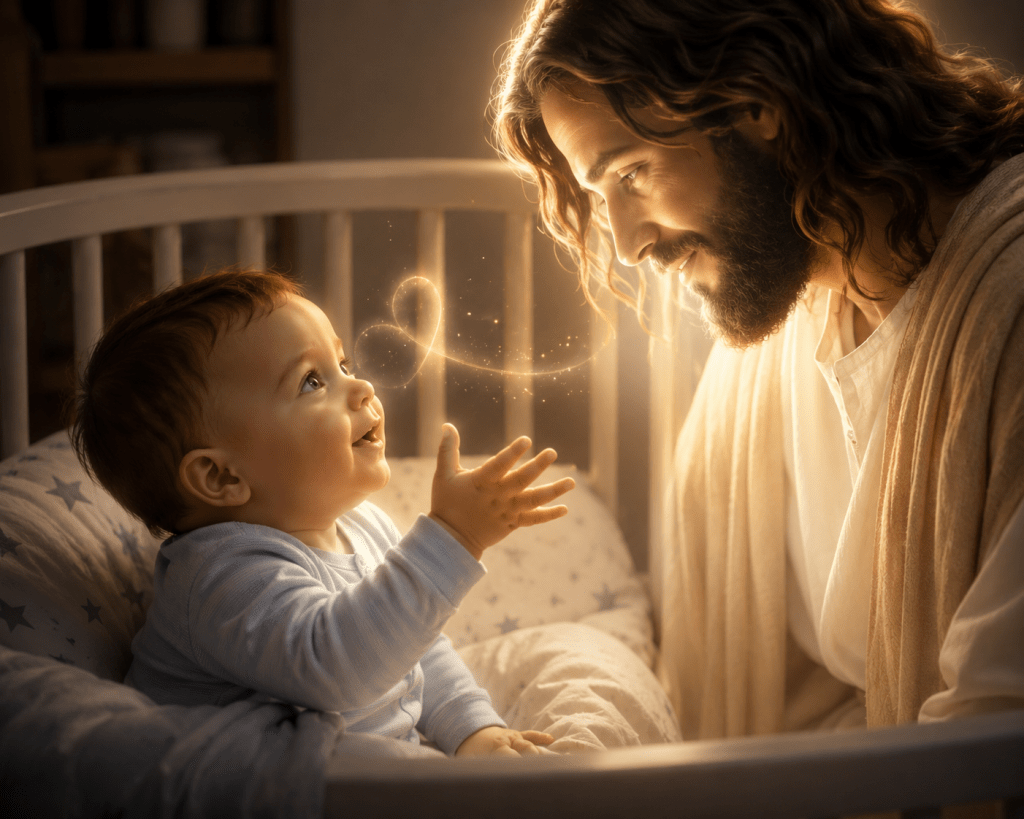
Have you ever watched a baby stare intently at an empty corner of a room, smiling as though someone is smiling back?
Or heard a small child speak about Jesus with such certainty and simplicity that it makes you wonder what they understand or perhaps what they see, that we adults have forgotten how to notice?
There is something beautiful about the faith of a child.
Children have not yet learned to analyze everything. They haven’t built all the walls that adulthood can bring. They haven’t suffered disappointments, stress, strain, so they are seeing everything with new eyes, trusting eyes. They don’t always need an explanation before they believe. Their hearts can be open to wonder, trust, and the possibility that there is more around us than what our physical eyes can see.
And perhaps there is a lesson for us there.
They See With Different Eyes
The Bible tells us that the spiritual world is real even though we cannot ordinarily see it with our physical eyes.
In 2 Kings 6, Elisha’s servant was terrified because an enemy army surrounded them. Elisha knew, however, that they were not alone.
He prayed:
“Lord, I pray thee, open his eyes, that he may see.” — 2 Kings 6:17
Then God opened the servant’s eyes, and he saw what had been there all along the mountain filled with horses and chariots of fire.
The reality didn’t suddenly appear. His eyes were simply opened to it.
That passage makes me think about children.
We should be careful about claiming with certainty what a baby or young child is seeing when they gaze, smile, point, or talk about Jesus. But their openness can remind us of something Scripture clearly teaches: there is more to God’s reality than what our natural eyes perceive.
Jesus Welcomed the Little Children
Jesus had a special tenderness toward children.
When people brought little children to Him and the disciples tried to send them away, Jesus said:
“Suffer the little children to come unto me, and forbid them not: for of such is the kingdom of God.” — Mark 10:14
Then He said something even more challenging:
“Whosoever shall not receive the kingdom of God as a little child, he shall not enter therein.” — Mark 10:15
Jesus wasn’t telling us to become childish.
He was showing us something about childlike faith.
A little child reaches for the hand of someone they trust without first demanding to know every detail of the journey.
That’s the kind of trust God desires from us.
Maybe We Have Learned to Look Too Hard
As adults, we want evidence.
We want answers.
We want to understand how, when, and why.
And when we cannot understand something, we sometimes struggle to believe it.
Children can be different.
They can accept mystery without needing to solve it.
Maybe that is part of what we’ve lost.
We become so dependent upon what we can see with our physical eyes that we forget Paul’s words:
“For we walk by faith, not by sight.” — 2 Corinthians 5:7
Faith doesn’t mean ignoring truth or abandoning wisdom. It means trusting God even when we cannot see the entire picture.
Sometimes our physical eyes can actually distract us from seeing spiritually.
We look at the impossible circumstances.
We look at the diagnosis.
We look at the empty bank account.
We look at the broken relationship.
We look at everything that tells us God couldn’t possibly be working.
Meanwhile, faith whispers:
Look again.
We Need That Blind Faith
Maybe what we need is a little more of that childlike, “blind” faith—not blindness to truth, but trust before sight.
Faith that says:
Jesus, I cannot see You, but I know You are here.
I don’t understand what You’re doing, but I trust You.
I cannot see the road ahead, but I will take Your hand.
Hebrews 11:1 tells us:
“Now faith is the substance of things hoped for, the evidence of things not seen.”
There it is again:
Things not seen.
I created this image using AI
The Christian life has never been about believing only what our eyes can prove.
It is about learning to see with the heart.
Lord, Open Our Eyes
Maybe instead of dismissing the wonder of children, we should allow it to challenge us.
When a little child talks freely about Jesus, perhaps we should listen.
When their prayers are simple and confident, perhaps we should learn from them.
When they believe Jesus loves them without requiring a theological explanation of every detail, perhaps we should remember what it felt like simply to trust.
Children don’t have all the answers.
Neither do we.
But Jesus never said we needed all the answers before coming to Him.
He asked us to believe.
Perhaps our prayer should be the same prayer Elisha prayed so long ago:
“Lord, open our eyes.”
Open our eyes to Your presence.
Open our eyes to Your goodness.
Open our eyes to what You’ve been doing while we’ve been worrying.
Open our eyes to the miracles we’ve stopped noticing.
Open our eyes to the spiritual reality beyond what we can touch and see.
And give us hearts like little children again—hearts willing to trust You before we understand everything.
Because maybe the faith that seems blind to this world is the very faith through which our eyes finally begin to open.
A Prayer
Jesus, give me the heart of a child.
Remove the doubt, fear, and distractions that keep me from recognizing Your presence. Teach me to trust You when I cannot see You and to believe when I don’t understand.
Lord, open the eyes of my heart.
Help me walk by faith and not merely by what my natural eyes can see. Give me that simple, beautiful, childlike trust that reaches for Your hand and knows You are near.
And when I become too busy, too skeptical, or too distracted to notice You, remind me to become still again.
A True Entertainer, Humanitarian, and Gift to the World
January 19, 1946 – August 25, 2026
Today, the world lost more than a country music legend. Brief battle with cancer.
We lost Dolly Parton a singer, songwriter, actress, author, businesswoman, philanthropist, humanitarian, and one of the most beloved entertainers of our time.
Dolly Parton died at the age of 80, leaving behind a legacy that reaches far beyond the songs she sang and the stages she stood upon.
For nearly seven decades, Dolly entertained the world. But perhaps the most beautiful part of her story is what she did when the spotlight wasn’t on her.
She gave back.
She gave children books.
She gave students opportunities.
She gave struggling families hope.
She gave communities jobs.
She gave money to medical research.
She helped people rebuild after disasters.
And through her music, humor, generosity and kindness, she gave millions of people something to smile about.
From the Mountains of Tennessee to the World
Dolly Rebecca Parton was born January 19, 1946, in rural Tennessee and grew up as one of 12 children in a family with very little money.
She never forgot where she came from.
She transformed that humble beginning into an extraordinary career as one of the most recognizable entertainers in history.
She wrote hundreds of songs and created classics including “Jolene,” “Coat of Many Colors,” “9 to 5” and “I Will Always Love You.”
Her recordings sold more than 100 million copies worldwide, and her music crossed the boundaries of country, pop, rock and gospel.
But Dolly wasn’t only a singer.
She became a movie star, appearing in beloved films including 9 to 5, The Best Little Whorehouse in Texas, and Steel Magnolias.
She became an author, producer, entrepreneur and theme-park visionary.
And then she used that success to help others.
She Put Millions of Books Into Children’s Hands
One of Dolly’s greatest accomplishments had nothing to do with a hit record.
It involved books.
Dolly’s father could not read or write. Seeing how deeply that affected his life inspired her to create Dolly Parton’s Imagination Library in 1995.
The idea was beautifully simple: give young children books for free.
Children enrolled in the program receive an age-appropriate book every month from birth until age five, regardless of their family’s income.
What began in Dolly’s home county in Tennessee became an international literacy movement.
By the time of her death, the Imagination Library had mailed more than 270 million free books to children, expanding across the United States and into Canada, the United Kingdom, Australia and Ireland.
Millions of children learned to love reading because Dolly Parton decided that a child’s circumstances should not determine whether there were books in their home.
She Helped Children Stay in School
Dolly founded The Dollywood Foundation in 1988 with a mission centered on education.
When her hometown struggled with high school dropout rates, Dolly created the Buddy Program.
She promised participating seventh- and eighth-grade students that if they graduated from high school, she would personally give them $500.
The dropout rate for those participating classes reportedly fell from 35 percent to 6 percent.
Her foundation also established scholarships to help young people pursue higher education.
Dolly understood that changing a child’s future could change an entire family for generations.
She Helped Families After the Tennessee Wildfires
When devastating wildfires struck Sevier County, Tennessee, in 2016, Dolly didn’t simply send her thoughts and prayers.
She took action.
She created the My People Fund to help families who had lost their homes.
Families received $1,000 per month for six months, and the relief effort ultimately distributed millions of dollars.
The fund eventually raised and provided more than $12 million to families affected by the disaster.
These weren’t strangers to Dolly.
They were, as she called them, “my people.”
She Helped Fund COVID-19 Vaccine Research
During one of the most frightening periods in modern history, Dolly once again stepped forward.
In 2020, she donated $1 million to Vanderbilt University Medical Center for coronavirus research.
Her contribution supported research connected to the development of the Moderna COVID-19 vaccine.
She also supported pediatric infectious-disease research at Vanderbilt.
The woman known around the world for songs such as “Jolene” quietly helped scientists doing work that would affect millions of lives.
She Supported Health Care for Women and Families
Dolly’s giving extended into health care in her home region.
Her philanthropy and fundraising helped support LeConte Medical Center in Tennessee, including services dedicated to women’s health and childbirth.
Her charitable work consistently reflected the same principle: when she saw a need she could help fill, she tried to fill it.
She Helped Her Community Create Jobs
Dolly never abandoned the mountains that raised her.
Dollywood became much more than a theme park bearing her name.
It helped transform tourism and employment in East Tennessee and provided generations of local families with jobs and economic opportunities.
Rather than leaving her hometown behind after becoming famous, Dolly brought opportunity home with her.
She Helped After Hurricane Helene
When Hurricane Helene brought devastating flooding to East Tennessee in 2024, Dolly once again answered the call.
She personally pledged $1 million to relief efforts, while her businesses and foundation joined broader efforts to assist communities recovering from the disaster.
Even late in her life, Dolly was still giving back to the mountains and people who had given her a beginning.
She Cared About Wildlife
Dolly’s compassion wasn’t limited to people.
Through Dollywood’s partnership with the American Eagle Foundation, she supported the Eagle Mountain Sanctuary, which provided care for non-releasable bald eagles and supported conservation and rehabilitation efforts.
She Opened Doors for Women
Dolly also changed what was possible for women in entertainment and business.
She entered a male-dominated country music industry and insisted on controlling her career, her songwriting and her intellectual property.
When Elvis Presley wanted to record “I Will Always Love You,” Dolly famously refused to surrender part of her publishing rights.
Years later, Whitney Houston’s recording became one of the most famous performances of the song in history.
Dolly showed generations of women that being kind did not mean surrendering control of their work.
She could be warm, funny and generous — and still be a formidable businesswoman.
She Brought People Together
Perhaps one of Dolly Parton’s greatest gifts cannot be measured in dollars, books, records or awards.
She brought people together.
People from different generations, backgrounds, beliefs and walks of life loved Dolly.
She rarely seemed interested in dividing people.
She made people laugh at themselves.
She embraced being different.
She reminded people that you could come from very little and still dream enormously.
She showed that success did not require forgetting where you came from.
And she demonstrated that wealth and fame could become tools for helping other people.
More Than an Entertainer
Dolly Parton received countless awards during her lifetime.
She won Grammys.
She entered halls of fame.
She became a movie star.
She sold millions upon millions of records.
She built businesses.
She became one of the most recognizable women on Earth.
But some of her greatest achievements will never sit inside a trophy case.
They are sitting on children’s bookshelves.
They are in the homes of families who were able to rebuild after losing everything.
They are in the lives of students who stayed in school.
They are in hospitals and research laboratories.
They are in the communities of East Tennessee.
They are in the memories of people who heard one of her songs during a difficult moment and somehow felt a little less alone.
Rest in Peace, Dolly Parton
Today, we say goodbye to a true entertainer.
A songwriter.
A storyteller.
A movie star.
A businesswoman.
A humanitarian.
A daughter of the Smoky Mountains who somehow became everyone’s Dolly.
She came from a family that didn’t have much money, but she spent her life showing the world just how rich a human being could be in generosity, creativity, humor and love.
Her voice will live forever through her music.
Her words will live forever through her songs.
And her generosity will continue every time another child opens a book delivered through the Imagination Library.
Rest in peace, Dolly Parton.
Thank you for the music.
Thank you for the laughter.
Thank you for the books.
Thank you for remembering the people who needed help.
Thank you for never forgetting where you came from.
And most of all, thank you for leaving the world better than you found it.
1946–2026
The world lost an icon today, but Dolly Parton’s legacy will keep singing for generations to come. Heaven gained an angel.
Sometimes I look at the world today and wonder, where is all of this heading?
The USA and Iran. Russia and Ukraine. Israel and Palestine.
War after war. Conflict after conflict.
And behind every headline are real people. Families. Children. Innocent lives caught in the middle.
Does anyone actually care about their people anymore?
The Bible warned us that wars would continue.
“And ye shall hear of wars and rumours of wars…” — Matthew 24:6
Revelation also speaks about the nations of the world being drawn into conflict.
And while all this is happening, technology is advancing at an incredible speed.
Look at China’s humanoid robot competitions. Robots can now run, fight, play sports and perform increasingly complicated tasks.
It makes you wonder: could these become the soldiers of the future?
Then there’s AI.
I use AI myself to help generate images and other things. It’s useful, but I’ve noticed how quickly it begins trying to anticipate what you want. After it thinks it understands you, it sometimes tries to assist in ways you never even asked for.
So what happens as AI becomes more powerful and is given more control?
That’s a serious question.
We are entering a world our grandparents could hardly have imagined: AI, humanoid robots, autonomous weapons, constant international conflict and technology advancing faster than society can understand it.
It can be scary.
But maybe instead of only asking “Where is the world heading?”, we should also ask:
“Where am I heading?”
Are we right with God?
Have we accepted Jesus Christ?
Are we living as though we have unlimited time to figure these things out later?
Jesus said:
“Watch therefore: for ye know not what hour your Lord doth come.” — Matthew 24:42
Nobody knows exactly what tomorrow will bring.
But we do know this world isn’t promised to last forever.
Maybe it’s time we stopped putting God off until tomorrow.
For thousands of years, God’s people have lived with one great hope:
The King is coming.
Jesus came the first time exactly as the prophets foretold. He was born in Bethlehem, died on a cross for our sins, rose from the grave, and ascended into heaven.
If God fulfilled every major prophecy concerning Christ’s first coming with astonishing precision, why would we doubt His promises about His second coming?
The final chapter of history has already been written.
The question is not if it will happen.
The question is:
Are we ready?
What Does Revelation Tell Us?
The book of Revelation is not meant to frighten believers—it is meant to reveal Jesus Christ in His glory and assure us that God wins.
While Christians hold different views on the timing and sequence of some prophetic events, many understand Scripture to describe a broad unfolding of these events:
Increasing spiritual deception and rebellion against God.
Growing turmoil among nations, accompanied by wars, natural disasters, and global instability.
A period of unprecedented tribulation unlike anything the world has experienced.
The visible return of Jesus Christ in power and glory.
Christ’s righteous reign as King.
The final defeat of Satan, the last judgment, and the creation of a new heaven and a new earth where God dwells with His people forever.
Through every stage, one truth remains constant:
Jesus Christ is Lord, and history is moving toward His Kingdom.
Are We Seeing the Stage Being Set?
No one knows the day or the hour of Christ’s return.
Jesus Himself made that clear.
But He also told His followers to watch, remain spiritually awake, and recognize the seasons.
When we look around today, many people notice increasing moral confusion, hostility toward biblical truth, widespread deception, conflict, anxiety, and a world searching desperately for answers.
These realities remind many Christians of Jesus’ warnings that believers should remain alert and faithful.
Rather than leading us to fear, they should lead us to hope, perseverance, and deeper trust in God.
Why You Need Your Bible More Than Ever
The greatest preparation for tomorrow is not endless scrolling through headlines.
It is opening God’s Word today.
Even ten minutes a day can begin transforming your life.
The Bible renews your mind when the world fills it with confusion.
It strengthens your spirit when you feel weak.
It teaches you to recognize truth when deception is everywhere.
It gives wisdom for daily decisions.
It brings peace when circumstances seem uncertain.
Most importantly, it draws you into a deeper relationship with Jesus Christ.
The more you know God’s Word, the more you recognize God’s voice.
And the more you recognize His voice, the more confidently you can walk through whatever lies ahead.
Our Greatest Need
Our world doesn’t need another political movement.
It doesn’t need another celebrity.
It doesn’t need another social media influencer.
It needs Jesus Christ.
Our greatest need is not simply to know about prophecy.
Our greatest need is to know the One to whom all prophecy points.
He is the Lamb who was slain.
He is the risen Savior.
He is the King of kings and Lord of lords.
One day every knee will bow and every tongue will confess that Jesus Christ is Lord.
The only question is whether we will bow to Him now in faith or later in judgment.
A Personal Invitation
If you’ve been putting off your relationship with God…
Don’t wait.
If your Bible has been collecting dust…
Open it today.
Start with the Gospel of John.
Read just ten minutes each day.
Ask God to help you understand what you’re reading.
He delights in revealing Himself to those who sincerely seek Him.
You don’t have to understand everything at once.
You simply have to begin.
The Story Ends…and Eternity Begins
From Genesis to Revelation, the Bible tells one magnificent story.
Creation.
The Fall.
God’s covenant promises.
The coming of the Messiah.
The Cross.
The Resurrection.
The birth of the Church.
The promised return of the King.
And finally…
A new heaven.
A new earth.
No more death.
No more pain.
No more tears.
Only the eternal reign of Jesus Christ with all who belong to Him.
That has always been God’s plan.
That has always been the hope of every believer.
And that hope is available to every person who places their trust in Jesus Christ.
Part 3 of 4: Israel, the Church, and God’s Unfolding Kingdom
One of the most debated questions in Bible prophecy is this:
What is God’s plan for Israel, and where does the Church fit into that plan?
To answer that question, we must remember something important:
God never breaks His promises.
Israel’s Rejection Was Not God’s Defeat
When Jesus came to Israel, many believed in Him, but the nation as a whole rejected Him as their Messiah.
Did that mean God’s promises to Israel were canceled?
The Apostle Paul answers with a resounding:
“Certainly not!” (Romans 11:1)
God had not abandoned His people.
Instead, something remarkable happened.
The Gospel began spreading to the Gentiles, and the Church was born.
What Is the Church?
The Church is not simply a building or denomination.
It is the body of Christ, made up of every believer Jew and Gentile alike who has placed their faith in Jesus Christ.
Paul describes believers as being “one new man” in Christ (Ephesians 2:15), united by grace rather than nationality.
The Church shares in the spiritual blessings of God’s promises through Christ.
But Scripture never says the Church replaces Israel.
Instead, God is accomplishing His purposes through both according to His perfect plan.
Has God Finished with Israel?
Romans chapters 9–11 provide one of the clearest answers in Scripture.
Paul writes:
“Has God rejected His people? By no means!”
He goes on to explain that Israel has experienced a temporary hardening until the fullness of the Gentiles has come in.
Then God’s redemptive work with Israel will continue according to His covenant promises.
The same God who promised Abraham a nation…
The same God who promised David an everlasting throne…
Is the same God who always keeps His Word.
His faithfulness never changes.
Looking Toward the Kingdom
Today we live in the age of God’s grace as the Gospel continues to spread throughout the world.
But this is not the end of the story.
The Bible points forward to a future restoration, the return of Christ, the defeat of evil, and the establishment of His righteous Kingdom.
God’s plan has never been divided.
It has always been moving toward one glorious destination:
The return of the King.
Coming Next…
In our final message, we will explore what the Bible says about Christ’s return, His Kingdom, the new heavens and new earth, and why every believer can live with confidence and hope today.
There is a reason the Bible remains the most read and best-selling book in human history. It isn’t a dusty relic of it’s a living, breathing story that connects your life straight to the heart of God. Join us as we trace His unbreakable promises…
Scripture tells one unfolding story: the arrival of a King and the establishment of His Kingdom. In this study, we will trace God’s covenant promises from Abraham to Jesus’ return, exploring where Israel and the Church fit into the future. Dive into prophecy and uncover the ultimate truth driving all of history—the King is coming back.
And my answer is probably not the one people expect.
No. I don’t believe everything happens for a reason.
I believe a lot of things happen because of the choices we make.
Sometimes they happen because of choices other people make.
Sometimes things happen because life is unpredictable.
And sometimes things happen because, well, people do stupid things.
I have certainly made my share of those decisions. If bad choices came with trophies, some of us would need a bigger shelf.
You know when I was 16 years old, some things happened to me in high school that turned me against wanting to be in high school and I quit , I quit going. I was jumped by several boys. I believe they were seniors one night. I was walking home from a basketball game I thought for sure I was gonna be raped. Did I think that happened for a specific reason no.. But thankfully, a friend of mine happened to be home from the military was driving down the road saw someone getting jumped by several boys got out of the car saw it was me and got me the heck out of there.
Was it my fault that I was walking a few blocks home in the dark from a basketball game? It was only 7 o’clock at night. I would say no I walked to the game with my friends walked home from the game with my friends, however a couple of my friends decided to stay longer and go drinking and I didn’t want to so I headed home thankfully I believe God was looking out for me and put my friend in that vicinity at the same time, could’ve been a stranger going down the street that it could’ve helped me possibly, but we don’t know.
I don’t truly believe everything happens for a reason.
And after I quit school, I went to work full-time knew I needed to finish my education and so I went back to school at night, and I ended up with my diploma a year before my graduating class.
I think there is a big difference between saying “everything happens for a reason” and saying “God can bring something good out of what happened.”
Those are not the same thing.
I believe deeply in God.
I believe in prayer.
I believe in grace.
I believe God can take our messes, mistakes, heartbreak, losses, failures, and even things we never asked for, and somehow help us find strength, wisdom, compassion, or purpose in them.
But I do not believe every painful thing that happens was deliberately placed in our lives because it was somehow “supposed to happen.”
Choices Matter
Take homelessness.
I do not believe every homeless person somehow ended up there because that was their destiny.
And I certainly do not believe God or the universe sat around one day saying, “Let’s make this person homeless and see what happens.”
Life is far more complicated than that.
Someone can have a good job, a home, a family, and a perfectly normal middle-class life.
Then the company closes.
We saw that happen in towns all across America when steel mills and factories shut down.
Thousands of people who had worked hard for years suddenly had no job. Men and women who had worked in the same company or Factory for 10, 20, 30+ years getting ready to retire maybe 60 years old now out of work and they’re wondering who is going to hire them when you have a 25 year-old competing for the same job who is probably college educated on top of everything else.

And when one company employs a huge percentage of a town, where exactly is everybody supposed to go?
The mortgage company still wants its money.
The electric company still sends the bill.
The grocery store does not accept “my company closed” as payment.
Savings disappear.
Unemployment runs out.
And eventually, some people lose their homes.
That did not happen because they were lazy.
It did not happen because God decided they needed a lesson.
It happened because circumstances changed.
Now some people could say well they could get a job anywhere. They’re just too particular well that may be true but you also have to think of a person‘s been at a company for 20 or 30 years even 10 years. They’re making a far better wage than somebody starting out at McDonald’s making a minimum wage and who’s to say that that job that they’re taking in a low pay is still gonna cover the mortgage in the bills..
Then there are other people who may become homeless because of addiction, gambling, poor financial choices, broken relationships, untreated mental health issues, or a combination of problems.
Every story is different.
That is one reason I try very hard not to look at someone’s current situation and assume I know how they got there.
We usually see the current chapter, but maybe not the last chapter .
We have no idea what happened in the first twenty chapters.
Sometimes Our Choices Catch Up With Us
Smoking is another example.
I started smoking cigarettes when I was 15 years old both my parents smoked, and I used to steal their pal mal’s of all the disgusting cigarettes to steal no filter disgusting. I upgraded Kool’s when I got a job after I quit school at 16.
And I smoked until I was about 50 I hated smoking. I hated the way it smelled. I hated the way my mouth tasted after I had a cigarette. It was just a nasty disgusting habit and I quit cold turkey and I have never picked up a cigarette since that’s been over 10 or 15 years now thank God.
If someone smokes for fifty years and later develops lung cancer, I do not believe the universe chose that person and said, “You’re next.”
Smoking damages the body.
We know that.
It is printed right on the package.
Now, nicotine is incredibly addictive, and I am not saying quitting is easy.
Some people try over and over again.
Some desperately want to stop and cannot.
Some do not want to stop.
Some tell themselves they will quit next year.
And next year somehow keeps moving.
But choices still have consequences.
That does not mean we should judge people.
It means we should understand that what we do today can affect us years from now.
The same thing can happen with drugs.
Addiction can completely change the direction of a person’s life.
Someone who might have built a business, raised a family, traveled the world, or lived a completely different life can end up losing jobs, relationships, money, freedom, and sometimes everything.
Not because they were born to fail.
Not because God wanted them destroyed.
But because addiction can take one choice and turn it into a road that becomes harder and harder to leave.
Our Choices Can Affect Innocent People Too
This is where I really struggle with the phrase “everything happens for a reason.”
Suppose I am driving and texting.
I look down at my phone.
I drift into another lane.
I hit another car.
Someone in that car is seriously injured.
Was that injury part of some grand cosmic plan?
I don’t believe that.
That person was injured because I made a terrible choice.
My stupidity became part of their life.
That is sobering when you think about it.
Our choices do not stay neatly contained inside our own lives.
They spill over.
They affect our husbands, wives, children, parents, friends, coworkers, neighbors, and sometimes complete strangers.
That is why responsibility matters.
That is why kindness matters.
That is why integrity matters.
That’s why doing the right thing when no one is watching matters.
And that is why your phone can absolutely wait until you get to the parking lot.
Some Things Just Happen
I also believe there are things that happen in life that have nothing to do with anyone’s choices.
Storms happen.
Accidents happen.
Illness happens.
A tree falls.
A person can do everything “right” and still receive a terrible diagnosis.
A perfectly healthy person can have something unexpected happen to them.
And sometimes beautiful things happen randomly too.
You sit beside someone you have never met and become lifelong friends.
You take a wrong turn and discover a place you love.
You miss one opportunity and later realize it pushed you toward something better.
Life is full of things we cannot explain.
And I think we do ourselves a disservice when we feel obligated to slap a little inspirational sticker on every painful experience that says:
“Everything happens for a reason.”
Sometimes people do not need a reason.
Sometimes they need a hug.
Sometimes they need somebody to sit beside them.
Sometimes they need someone to say:
“I don’t understand why this happened either, but I’m here.”
That can be far more Christlike than trying to explain somebody’s suffering.
Where I Believe God Comes In
This is where my faith becomes very important to me.
I do not believe God causes tragedy.
But I do believe God can meet us in one.
I believe He can help us rebuild.
I believe He can take something that nearly destroyed us and somehow use it to make us more compassionate toward another person.
I believe He can take our mistakes and teach us.
I believe He can take our regrets and help us make better choices.
I believe He can take our heartbreak and soften our hearts instead of hardening them.
And I believe He can take something we never would have chosen and still help us find purpose on the other side.
That is the God I believe in.
Not a God sitting in Heaven moving people around like chess pieces.
But a loving Father who walks with us through this complicated, beautiful, painful, ridiculous thing called life.
Jesus never promised us that life would be easy.
In fact, He said the opposite:
“In this world you will have trouble.”
But He also told us not to lose heart.
That matters to me.
Because faith does not mean pretending nothing bad will happen.
Faith means believing bad things do not have to have the final word.
So No, I Don’t Believe Everything Happens for a Reason
I believe choices matter.
I believe consequences are real.
I believe other people’s decisions can change our lives.
I believe random things happen.
I believe we live in an imperfect world filled with imperfect people.
But I also believe in something bigger.
I believe God can take what happened and help us decide what happens next.
Maybe the question should not always be:
“Why did this happen to me?”
Maybe sometimes the better question is:
“God, now that this has happened, what can I do with it?”
Can I learn from it?
Can I grow from it?
Can I help someone else?
Can I forgive?
Can I change?
Can I become kinder?
Can I make sure somebody else does not have to walk the same road alone?
Because maybe everything does not happen for a reason.
But with faith, grace, wisdom, and a few better choices along the way, I believe we can still find purpose in what happens.
And sometimes, that purpose becomes one of the most beautiful parts of the story.